Do you have habits? Of course you do. We all do. Maybe it’s brushing your teeth every morning when you get up and every night before bed. Maybe it’s the route you take to work each day or how you grab a cup of coffee at the same spot before going into your office. Habits are those things we do without thinking. If you have ever found yourself beginning to exit a highway on a ramp where you drive every day when you should keep going straight, this is what habits do; they put us on automatic.
Habits can work for good or bad depending on the purpose and end of the habit. Cigarette smoking or taking addictive drugs, for example, fall into the bad category because their purpose is to provide short-term pleasure as a diversion from other problems with the unfortunate end of health issues. However, a habit of saying thank you is good. Its purpose is to show appreciation with an endgame of making you and others feel some joy.
The impact of habits is not just for individuals either. Groups or organizations can develop and practice habits, too, and they, like personal habits, can be good or bad—a help or a hindrance.
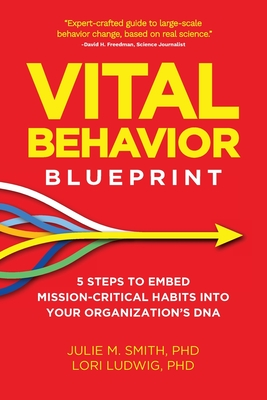
When organizational habits become obstacles to productivity, performance, or service, they are like carrying heavy baggage that exhausts you. But when the habits streamline things and enable better work and service, they help people and define your business in beneficial ways. The key to the latter is finding the vital behaviors that will be of most benefit. Finding these habits and then plugging them into your culture so everyone is rowing together is the essential theme of Julie Smith and Lori Ludwig’s book, Vital Behavior Blueprint.
The book is very easy to follow as it walks you step by step through finding the best behaviors to tackle and then how to make them live as true habits in your organization.
It begins with an explanation of what vital behaviors are, how they work, and how to make them work. Smith and Ludwig then lay out their blueprint methodology and walk you through each step with an actual example. I found this like reading the lyrics to a song as it plays. When you know the words, it makes much more sense.
Following this, they present a few real-world examples of organizations that have successfully implemented the process. These stories made it clear that the process is not cut in stone and inalterable; rather, it has room for adaptation to different situations.
Finally, they give a few short science lessons on behavior change, behavior management, and how to navigate emotions and change.
For such a big topic, the authors manage to get it done in just over 200 pages with just enough “heady” information to give it its due weight.
If you look around your organization and see that the way you and your team do things is just not as good as it could be, give this book a read. You may find answers, and those answers are not nearly as difficult as you think, especially when you have a guide.
==> If you want to know when new posts are published, CLICK HERE to subscribe.
 Neal Woodson