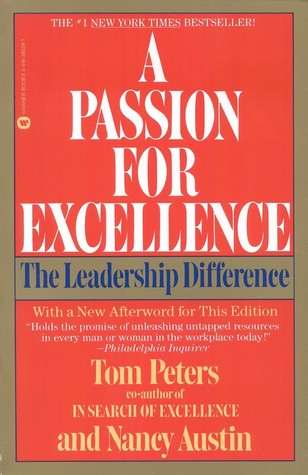
I recently read A Passion for Excellence, co-authored by Tom Peters and Nancy Austin. It’s an oldie; mine says it was published in 1985, but it was worth the read.
The writing oscillates between Austin’s measured, conservative style and Peters’ “don’t just sit there, do something” approach, and while one might think this would cause abrupt, uncomfortable shifts, the two find a way to blend it effortlessly.
Generally speaking, the book advocates for a cultural shift within organizations that relies on putting people, both customers and employees, at the center. Specifically, the book articulates a framework centered on the themes of care for customers, constant innovation, and leadership’s responsibility to build strong relationships with customers and employees by listening, observing, and inspiring change that benefits individual stakeholders as well as the broader organization.
Throughout the book, the authors argue for a commitment to excellence as the key driver of success. And when they speak of excellence, they make it clear that it is not a goal or destination but rather a continuous pursuit of improvement and adaptation to stay on the cutting edge of the rapid change all around us.
The book is in five sections, each with a singular focus.
1. Common Sense: This section introduces us to the book’s key ideas with the caveat that there is really nothing new here and that it is really just a compendium of rarely applied common sense. This quote from a friend of Peters tells us precisely what this section is trying to say: “I guess the obvious must not be so obvious, or more people would practice it.”
2. Customers: The key theme here focuses on the importance of truly understanding customer needs and building genuine relationships with them. By citing several examples of companies that excel in customer service and engagement, the authors pound home the idea that satisfied customers contribute significantly to long-term success.
3. Innovation: For excellence to live in organizations, they must cultivate their ability to innovate and respond to changing market conditions. The authors urge organizations to remain agile and open to new ideas, continuously learning and adapting to stay relevant and ahead of the game.
4. People: Empowering, engaging, and encouraging employees at all levels of the organization is, the authors stress, a quintessential need if organizations truly want to benefit from the work of excellence. They argue that organizations need to create environments where employees feel valued, are encouraged to take initiative, and have the freedom to pursue creativity. To shore up their thesis, they present examples of cultures where engaged employees deliver exceptional service and provide key contributions that drive their company’s success.
5. Leadership: The role of leadership is viewed as central to establishing a culture of excellence. Leaders are encouraged to model exemplary behavior, foster open communication, and instill a shared vision that aligns the entire organization towards the pursuit of excellence. An ever-present idea that comes out of Peters’ first book, In Search of Excellence, is MBWA, or Managing by Wandering Around. It is Peters’ contention that this activity is a prime responsibility of good leaders. If they want their organizations to stay vital and continually improving, they absolutely must spend an inordinate amount of their time getting to know people, whether customers, employees, or suppliers.
Throughout the text, Peters and Austin use real-world examples to illustrate their points. In addition, they provide practical advice and strategies for organizations, leaders, or anyone looking to embark on the excellence journey.
A Passion for Excellence is not only a guide to achieving high performance in business; it can also be seen as an inspiring call to adopt a mindset centered on quality, commitment, and continuous improvement. I found the themes and ideas in this book relevant and inspiring, even though it is 40 years old. If you happen to come across a copy, pick it up, have a read, and savor the many nuggets that will make you think and hopefully act to make your work, leadership, and business more successful.
==> If you want to know when new posts are published, CLICK HERE to subscribe.
 Neal Woodson